
5.4 Plant hormones
5.4.1 Control and coordination
FSL: GCSE Biology Revision "Plant hormones"
- Plants produce hormones to coordinate and control growth and
responses.
- Phototropism is response to light.
- Gravitropism or geotropism is response to gravity.
- Hydrotropism is response to water.
- Shoots are positively phototropic and negatively gravitropic (grow
towards light and away from gravity).
- Roots are negatively phototropic, positively hydrotrophic, and positively gravitropic (grow
away from light and towards water and gravity).
- Ethene controls cell division and ripening of fruits.
Auxin
- Auxin is a plant hormone that controls growth near the tips of shoots
and roots.
- They are made in the meristem.
- Auxin stimulates growth in shoots and inhibits growth in roots.
- In shoots, more auxin accumulates on the shaded side, causing the
cells there to elongate faster. This makes the shoot bend towards the
light.
- In roots, more auxin accumulates on the lower side, inhibiting cell
elongation there. This makes the root bend downwards.
Phototropism
- The light hits the plant shoot
- Auxin will diffuse from the tip
- It will acculumate on the dark side
- Cells on the dark side elongate faster
- The shoot grows and bends towards the light
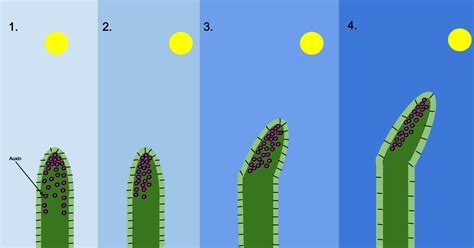 source
 Germination
- In roots the side with LESS auxins grow more, causing the root to grow downwards.
- In shoots the side with MORE auxins grow more, causing the shoot to grow upwards.
- This is important for seed germination, as the shoot needs to grow
upwards to reach the light for photosynthesis, and the root needs to
grow downwards to reach the water and minerals in the soil.
- It knows which direction to grow in because of gravity.
- Gibberellins are important in initiating seed germination.
- They stimulate the seed to break dormancy and start germination.
Required practical activity 8: investigate the effect of light or gravity on the growth of newly germinated seedlings
Materials: Cardboard box, Window sill, Paper cones, Dark cupboard, Lamp, Ruler, Petri dish, cress seeds, Cotton wool, Water, Measuring cylinder, Protractor, String.
- Label three setups: "Window", "Dark", "Side light".
- Prepare three Petri dishes: place a layer of cotton wool in each dish and wet with a measured amount of water (use the measuring cylinder, e.g. 10 ml each).
- Sow ~20 cress seeds evenly on each cotton wool layer.
- Window setup: place one dish on a window sill so light comes from the window.
- Dark setup: put one dish inside a cardboard box or in a dark cupboard so it receives no light.
- Side light setup: place the third dish in a open area and shine a lamp at it from one side. Use paper cones around the lamp to make the light directional if needed, or attach the lamp with string so the light stays steady.
- Keep temperature and water the same for all setups. Use the same type and amount of cotton wool and the same number of seeds to control variables.
- Every day for several days measure each seedling's angle of growth with a protractor and its length with a ruler. Record three repeats for each condition and calculate the mean.
- Use the same person and method for taking measurements to reduce error. Photograph or sketch results for reference.
- Dispose of biological material safely after the experiment and wash hands.
- Repeat all this five times to make sure data is repeatable.
Notes: use the cardboard box or dark cupboard for the "no light" control, the window sill for natural directional light, and the lamp with paper cones or string supports to create an artificial directional light source. The measuring cylinder ensures equal water volumes in each Petri dish.
| Condition | Angle the cress grew (°) | |||
|---|---|---|---|---|
| Repeat 1 | Repeat 2 | Repeat 3 | Mean | |
| By a window | ||||
| In the dark | ||||
| Box with hole cut out | ||||

5.4.2 Uses of plant hormones
FSL: GCSE Biology Revision "Uses of plant hormones"
- Auxins are plant hormones that serve multiple purposes in agriculture and horticulture.
- They are commonly used as selective weed killers, which target and kill unwanted plants without harming crops.
- They are also used as rooting powders to encourage root development in plant cuttings.
- Auxins are also used to promote tissue culture, allowing for the mass production of plants.
- They help control seed dormancy, allowing seeds to germinate by breaking their dormancy period.
- Gibberellins also promote flowering in various plants.
- Furthermore, they are used to increase the size of fruits, making them more appealing for sale.
- It accelerates the ripening process of fruits during transport, ensuring they reach stores in optimal condition.
- Ethene is also applied in stores to speed up the ripening of fruits, making them ready for consumers.