
6.1 Reproduction
6.1.1 Sexual and asexual reproduction & 6.1.3 Advantages and disadvantages of sexual and asexual reproduction
FSL: GCSE Biology Revision "Sexual and asexual reproduction"
Asexual reproduction
- Involves one individual (parent), no fusion of gametes.
- No mixing of genetic information, offspring are genetically identical to parent (clones).
- Only mitosis is involved.
- Examples: Bacteria (binary fission), some plants (potato tubers grow shoots and roots; strawberry plants produce runners;
spider plants grow plantlets on the ends of long stems), some animals (hydra by budding).
Sexual reproduction
- Two parents.
- Fusion of male and female gametes to form a zygote.
- Mixing of genetic information, offspring are genetically different to parents.
- Involves meiosis (to produce gametes) and fertilisation (fusion of gametes).
- Leads to genetic variation in offspring.
- Gametes formed by meiosis, zygote divides by mitosis.
- Examples: Most animals and plants.
Advantages of sexual and asexual reproduction
| Asexual reproduction | Sexual reproduction |
|---|---|
|
|
6.1.2 Meiosis
FSL: GCSE Biology Revision "Meiosis and fertilisation"
Images from here and here
- Cells in reproductive organs (testes and ovaries) divide by meiosis to produce gametes (sperm and egg).
- Each times the cell divides, cytokinesis has to happen.
- Interphase: The DNA of each chromosome is replicated.
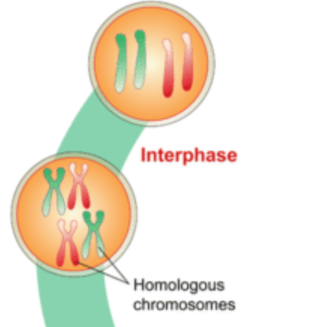
- Chromosomes pair up and swap alleles. This creates variation.
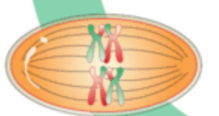
- Chromosomes line up in the centre of the cell arranged in their pairs. The way chromosomes line up is random, creating variation.
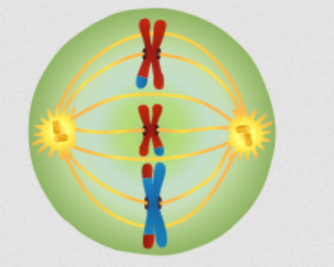
- One chromosome from each pair are pulled to opposite ends of the cell via spindle fibres. The cell divides into two.
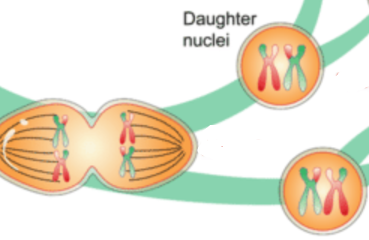
- One chromosome from each pair is pulled to opposite ends of the cell via spindle fibres. The cells divide again to form four gametes, each with a single set of chromosomes (haploid).
These are genetically unique. Each cell has 23 chromosomes.
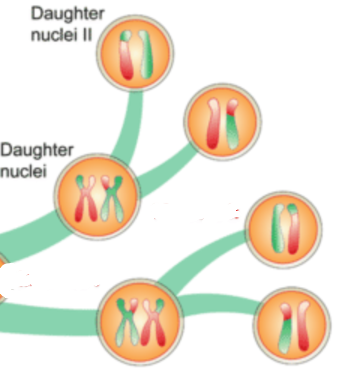
How sexual reproduction leads to variation
- Chromosomes line up at the equator.
- The way they line up is random (independent segregation).
- During meiosis chromosomes swap alleles (crossing over).
- Fertilisation is random (any sperm can fertilise any egg).
- This produces genetic variation in offspring.
| Mitosis | Meiosis |
|---|---|
| Chromosomes replicate, which copies the genetic information | Chromosomes replicate, which copies the genetic information |
| Only one cell division occurs | Two cell divisions occur |
| One copy of each chromosome (a chromatid) goes to each of the new daughter cells | Only half of the chromosomes go to each of the new daughter cells |
| Two daughter cells produced | Four daughter cells produced |
| Produces genetically identical cells | Daughter cells are all genetically different |
| Occurs during growth and asexual reproduction | Occurs during sexual reproduction to produce gametes |
6.1.3 Advantages and disadvantages of sexual and asexual reproduction part 2
FSL: GCSE Biology Revision "Advantages and disadvantages of sexual and asexual reproduction"
Malaria Life Cycle
- Malaria is caused by a parasite that is spread by mosquitoes.
- The infected mosquito bites an infected human.
- A blood temperature drop int he mosquito triggers sexual reproduction of the parasite.
- The male and female form of the parasite meet in the mosquito's gut to form a diploid cell (which has variation).
- The diploid zygote divides by mitosis to make loads of copies.
- Diploid cells travel to the saliva of the mosquito.
- In the Human:
- The mosquito bites another human host, and diploid parasites travel to the liver to mature/reproduce asexually.
- Malaria released from liver cells to invade red blood cells.
- More asexual reproductions happens in RBCs causing them to burst.
- This causes symptoms of fevers & fatigue.
Types of reproduction in fungi
- Fungi usually reproduce asexually.
- Many fungi are made up of a mass of thin threads called hyphae (these form visible structures called mycelium).
- The hyphae produce spores by mitosis (asexual reproduction). These spores can then grow into new fungi.
- Some fungi can also reproduce sexually. During poor conditions (e.g. when it's dry), cells in the hyphae of
two fungi undergo meiosis to form haploid cells.
- Two hyphae from different fungi join (haploid).
- Nuclei from hyphae fuse forming a diploid cell.
- This allows genetic variation.
6.1.4 DNA and the Genome & 6.1.5 DNA structure
FSL: GCSE Biology Revision "DNA and the Genome"
- DNA is a polymer made up of two strands forming a double helix.
- DNA is made up of lots of monomers called nucleotides.
- Nucleotides are joined together into polymers, creating two strands, forming a double helix.
- Each nucleotide consists of a sugar, a phosphate group and a base.
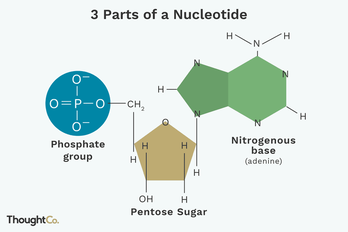 source
- The sugar and phosphate groups form the backbone of the DNA strands.
- The bases stick out from the backbone.
- There are four different bases: Adenine (A), Thymine (T), Cytosine (C) and Guanine (G).
- The bases pair up in specific ways: A with T, C with G (complementary base pairing).
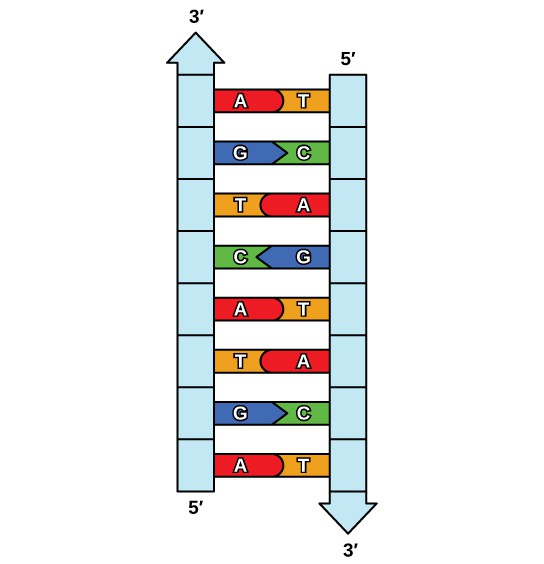 source
Chromosomes
- DNA forms structures in the nucleus called chromosomes.
- A small section on a chromosome is a gene.
- A gene codes for a specific sequence of amino acids to make a specific protein.
- The genome is the entire set of genetic material in an organism.
- In humans, the genome is made up of 23 pairs of chromosomes (46 total).
- Humans have about 20,000-25,000 genes.
Organisation of genetic material
- Smallest to largest:
- Nucleotide
- Gene
- Chromosome
- DNA (Genome)
- Nucleus
- Cell
Genome Sequencing
- The Human Genome Project was an international project to sequence the entire human genome.
- It was completed in 2003 after 12 years and US$3 billion.
- Knowing the human genome has allowed scientists to identify genes linked to different diseases.
- It has helped in the development of effective treatments (e.g. cancer, repair of faulty genes, personalised medicine).
- It also allows us to understand and study inherited disorders.
- It has also helped us understand human evolution and migration patterns.
- It could also be used to help people make informed choices e.g. how much alcohol is safe to drink.
- However, it could potentially be used by insurance companies or employers to discriminate against
people with certain genetic disorders, for example by charging more money for health/life insurance.
- This could also make people decide to not have children if they know they might inherit a disorder, or to
have 'designer babies' where embryos are selected based on preferred characteristics.
- Some sequences we do not understand the function of yet.
Protein Synthesis
- Protein synthesis is the process of producing proteins at the ribosome using genetic information from the nucleus.
- In the complementary strands a C is always linked to a G on the opposite strand and a T to an A.
- mRNA is made in the nucleus during transcription and sent to the ribosome.
- The DNA splits and is used as a template to make a complementary strand of mRNA (messenger RNA).
- The mRNA leaves the nucleus and goes to the ribosome.
- The mRNA is small enough to fit through the nuclear pores.
- The DNS then zips back up again.
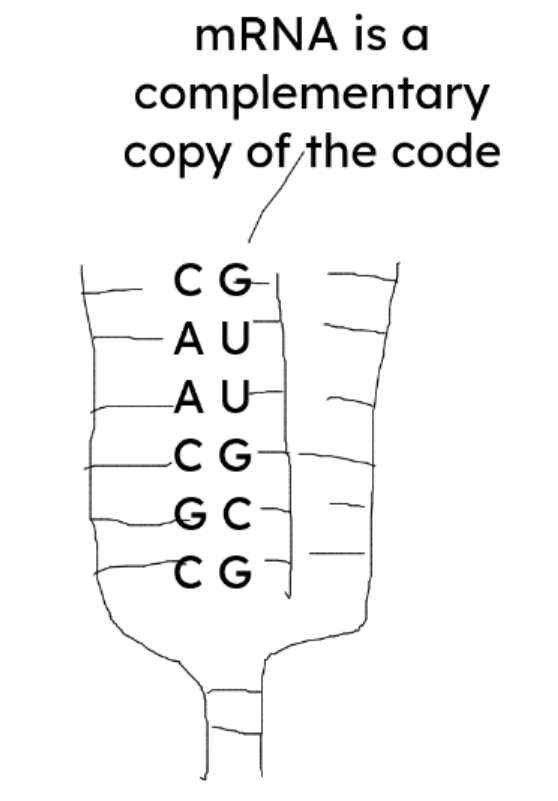 - When the mRNA reaches the ribosome, the mRNA attaches to it and translation begins.
- The ribosome reads the mRNA in sets of three bases because three bases code for one amino acid (a codon).
- tRNA (transfer RNA) molecules bring the correct amino acids to the ribosome in the correct order.
- The amino acids are joined together by the ribosome and fold to form a polypeptide chain (protein).
- This could be a hormone, enzyme, or a structural protein (collagen/keratin).
How the structure of DNA is related to its function
- Long molecule, can store lots of information.
- The base sequence allows information to be stored to build specific proteins.
- Hydrogen bonds are easy to break for replication.
- Double helix is more stable (won't break apart).
6.1.6 Genetic inheritance
FSL: GCSE Biology Revision "Mutation"
(from spec)
- Some characteristics are controlled by a single gene, such as: fur colour
in mice; and red-green colour blindness in humans. Each gene may have
different forms called alleles.
- The alleles present, or genotype, operate at a molecular level to develop
characteristics that can be expressed as a phenotype.
- A dominant allele is always expressed, even if only one copy is present.
- A recessive allele is only expressed if two copies are present (therefore
no dominant allele present).
- If the two alleles present are the same the organism is homozygous for
that trait, but if the alleles are different they are heterozygous.
Most characteristics are a result of multiple genes interacting, rather
than a single gene.
Mutations
- A mutation is a change in the sequence of bases in the genetic code.
- Most characteristics are controlled by different genes - it is mutations that cause variation.
- Useful: antibiotic resistance (in bacteria), faster predators / prey.
- Not useful: mutations causing albinism (lack of pigment) in animals.
- Most of the time mutations have no effect on the phenotype (if it codes for the same amino acid) - silent mutation.
- Mutation (random) is caused by cell divsion, radiation, and other substances that change DNA.
Switching genes on and off
- Genes can be switched on and off to direct the structure and/or function of a cell.
- Genes are regulated by the non-coding regions.
- Sometimes multiple genes are switched on to express a certain characteristic.
- Variations in the non-coding areas may affect how our genes are expessed whcih can in turn affect the phenotype.
Inheritance in Action
- Humans have two copies of every chromosome, and therefore every gene (one from each parent).
- Each copy of a gene may be a different allele.
- Your phenotype is the characteristics you have (e.g. eye colour, hair colour).
- Your genotype is the alleles you have for a particular gene (e.g. Bb for brown eyes).
- A heterozygous organism has two different alleles for a particular gene (e.g. Bb).
- A homozygous organism has two identical alleles for a particular gene (e.g. BB or bb).
- The dominant allele is always expressed in the phenotype, even if only one copy is present,
and is shown through the uppercase letter (e.g. B in Bb).
- The recessive allele is only expressed in the phenotype if both / two copies are present,
and is shown through the lowercase letter (e.g. b in bb).
- An organism can still carry the recessive allele without expressing it in the phenotype, which means
that if mating with another carrier occurs, the offspring could inherit the recessive allele from
both parents and express it in the phenotype.
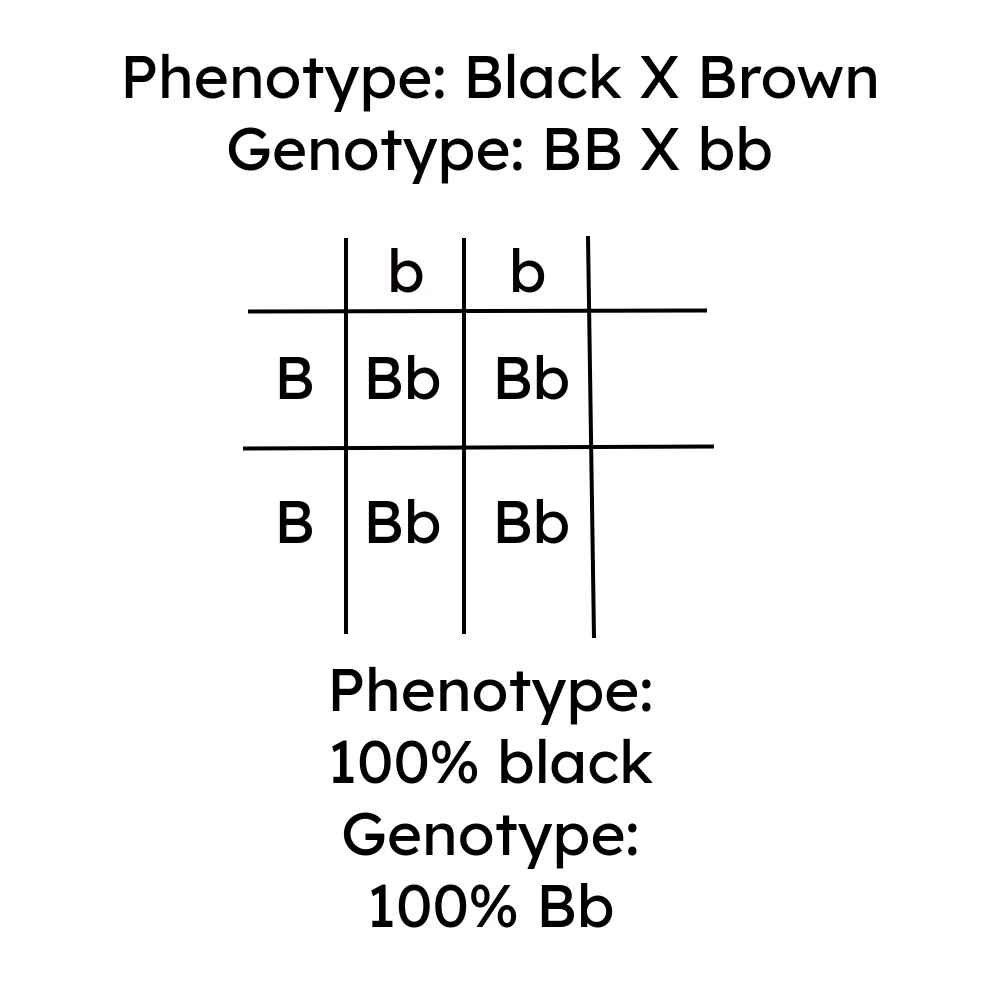
Punnett Squares
- A Punnett square is a diagram that can be used to predict the outcome of a particular genotype or phenotype.
- Each parent's alleles are written on the top and side of the square.
- The possible combinations of alleles in the offspring are filled in the boxes.
- From this, the genotypic and phenotypic ratios of the offspring can be determined.
6.1.7 Inherited disorders & 6.1.8 Sex determination
FSL: GCSE Biology Revision "Inheritance of Sex"
FSL: GCSE Biology Revision "Cystic Fibrosis"
Sex determination
- Ordinary human body cells contain 23 pairs of chromosomes (unless you have down syndrome etc).
- 22 pairs control characteristics only, but one of the pairs carries the genes that determine sex.
- In (the majority of) females the sex chromosomes are the same (XX).
- In (the majority of) males the chromosomes are different (XY).
Polydactyly
- Determined by a dominant allele (P).
- Only one copy of the allele is required.
- Multiple digits (toes / fingers / tissue).
Cystic Fibrosis
- Determined by a recessive allele (f).
- Two copies of the allele are required.
- Affects the mucus-producing glands, digestive enzymes and sweat glands.
- Build up of sticky mucus in the lungs.
- Blocks pancreatic ducts that affects digestion and enzymes from working.
Genetic screening
- Foetuses can be screened for the allels that cause inherited disorders.
- Embryos can be screened before they are implanted into the mother during IVF treatment.
- Screening is done through amniocentesis or chorionic villus sampling (CVS).
- People may choose to screen if there is an unusual ultrasound scan, there are previous
children with genetic disorders, a family history of genetic disorders, or if the mother is over 35 years old.
CVS
Embryonic cells are screened between 10 and 12 weeks of pregnancy.
- A small sample of tissue is taken from the developing placenta.
- This provides fetal cells for genetic screening.
Amniocentesis
Carried out at 15-16 weeks of pregnancy.
- Fluid is taken from around the developing fetus.
- This fluid contains fetal cells for genetic screening.
- It has a risk of miscarraige therefore is usually only offered if there is a higher risk of genetic disorders.
Advantages and disadvantages of genetic screening
| Advantages | Disadvantages |
|---|---|
|
|