
6.2 Variation and Evolution
6.2.1 Variation & 6.2.2 Evolution
FSL: GCSE Biology Revision "Variation"
- Variation is a difference in characteristics between individuals of the same species caused by
random mutations.
- Genetic variation is caused by different alleles and mutations.
- Environmental variation is caused by the environment / surroundings.
- the genes they have inherited (genetic causes)
- the conditions in which they have developed (environmental causes)
- a combination of genes and the environment.
Natural Selection
- Natural selection is a mechanism of evolution that explains how organisms better suited to their environment are more likely to survive and reproduce.
Discrete Variation
- The data can only be a limited set of value e.g. blood group, eye colour, hair colour.
- Represented by a bar or pie chart.
Continuous Variation
- The data can be any value in a range e.g. height, mass.
- Represented by a scatter graph or histogram.
6 mark answer structure example
Explain why male red deer have large antlers
- There is a variation of alleles in the population of deer
- Random mutations give rise to deer with large antlers
- The environment changes which is a selection pressure
- Deer with smaller antlers lose more fights so get poorer land / fewer mates so they are more likely to die
- Deer with bigger antlers are more likely to survive, reproduce, and pass on their large antler alleles
- Frequency of deer with alleles for larger antlers increases over generations
6.2.3 Selective Breeding
FSL: GCSE Biology Revision "Selective Breeding"
- Selective breeding (artificial selection) is the process by which humans breed plants and animals for
particular genetic characteristics.
- Humans have been doing this for thousands of years since they first bred food crops from wild plants
and domesticated animals.
- Selective breeding involves choosing parents with the desired characteristic from a mixed population. They are bred together.
- From the offspring those with the desired characteristic are bred together. This continues over many
generations until all the offspring show the desired characteristics.
- Yes we're ignoring inbreeding here just roll with it.
Selective breeding scaffold
- Desirable characteristics selected.
- A male and female are selected showing desireable traits in the phenotype. Breed them together.
- Select offspring that show that characteristic / phenotype.
- Breed these offspring together and repeat continuously over many generations.
- Eventually all (or nearly all) offspring show the desired characteristic.
Benefits and Disadvantages
| Benefits | Drawbacks |
|---|---|
|
|
6.2.4 Genetic Engineering
FSL: GCSE Biology Revision "Genetic Engineering"
Genetic Engineering is a process by which changes the genome of an organism by inserting a gene from another organism to give it a desired characteristic.
- To produce human insulin, bacteria are genetically modified to contain the human insulin gene. The bacteria can then produce insulin which is extracted and used to treat diabetes.
Steps of Genetic Engineering
- Identify the gene we want to transfer
- Use enzymes to cut out the gene
- Transfer the gene into a small circle of DNA called a plasmid
- The desired gene is transferred to the cells of the target organism (at an early stage in their development so that they develop with desired characteristics)
Genetic Engineering to produce Insulin
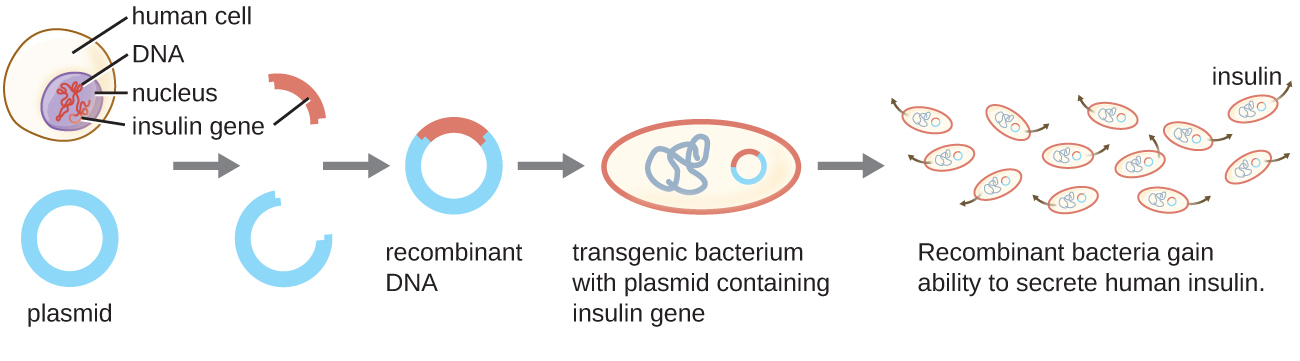 source
 Advantages and Disadvantages of Genetic Engineering
Benefits:
- Can produce large amounts of proteins like insulin and other drugs very fast
- Human insulin made this way will not be rejected by the body
- It could allow treatment for some human genetic disorders in the future
- Genetic engineering is expensive
- It can lead to unintended consequences in the environment or health of organisms
Benefits and Drawbacks of GM Crops
Advantages:
- Genetically modifying crops to be resistant to pests or diseases increases yield and allows better grwoth
- GM plants can be used to produce more food or more nutritious food in places where they cannot grow lots
- It can reduce the use of chemical pesticides
- Inserted genes could be transferred to wild populations of plants which could affect biodiversity of plants and insects that feed on them, especially resistance genes.
- Some people feel that the health implications of GM crops have not been fully explored, and there are ethical concerns about the use of genetic engineering in agriculture
Examples
- Golden rice is a GM crop that has been modified to produce beta-carotene, which the body can convert into vitamin A.
This is important for people in developing countries who may not get enough vitamin A from their diet, as it can help
prevent blindness and other health problems. Ethical concerns include widening access divides in late-stage capitalist
society and treating a symptom rather than addressing root causes of malnutrition.
- Herbicide-resistant soy is a GM crop that has been modified to be resistant to herbicides, allowing farmers to use
herbicides to control weeds without harming the crop. This can increase yield and reduce the need for manual weeding.
Ethical concerns include agriculture corporations gaining more control and mess with biodiversity of wild plants and insects.
- Gene therapy for cystic fibrosis is a potential application of genetic engineering in medicine, where the faulty gene
responsible for cystic fibrosis could be replaced with a healthy copy to treat the disease. Ethical concerns include
the safety and long-term effects of gene therapy, as well as issues of access and equality in healthcare.
6.2.5 Cloning
FSL: GCSE Biology Revision "Cloning Animals" and GCSE Biology Revision "Cloning Plants"
- Cloning is producing individual organisms that are genetically identical to the parent organism.
- Natural cloning occurs in some plants and animals e.g. identical twins, strawberry runners, bacteria dividing by binary fission.
- Artificial cloning can be done by cuttings in plants, and by embryo transplants or adult cell cloning in animals.
- Tissue culture: using small groups of cells from part of a plant to grow identical new plants.
This involves placing plant cells in a nutrient medium where they divide and develop into complete plants.
Important for preserving rare plant species or commercially in nurseries.
- Positives: Thousands of plants made at once and used to preserve rare plants. Negatives: Expensive and requires specialised equipment.
- Cuttings: an older, but simple, method used by gardeners to produce many identical new plants from a parent plant.
A small section of stem or leaf is cut from the parent plant and placed in soil where it develops roots and grows into a new identical plant.
- Positives: Simple and cheap. Negatives: Only a few plants can be made at once and it can take a long time for the new plant to grow.
- Embryo transplants: splitting apart cells from a developing animal embryo before they become specialised, then transplanting
the identical embryos into host mothers. Each separated cell can develop into a complete organism genetically identical to the others.
- Positives: Can produce many identical animals at once, and embryos are easier to transport. Negatives: Expensive and requires specialised scientists.
Adult Cell Cloning
(using Sheep A, B, and C as an example)
- The nucleus is removed from an unfertilised egg cell, extracted from Sheep B.
- The nucleus from an adult body cell, such as a skin cell, is removed from Sheep A and inserted into the egg cell.
- An electric shock stimulates the egg cell to divide to form an embryo.
- These embryo cells contain the same genetic information as the adult skin cell.
- When the embryo has developed into a ball of cells, it is inserted into the womb of Sheep C to continue its development.
- The lamb born is genetically identical to Sheep A.