
7.4 Trophic levels in an ecosystem
7.4.1 Trophic levels
FSL: GCSE Biology Revision "Trophic Levels"
- Trophic levels can be represented by numbers, starting at level 1 with
plants and algae. Further trophic levels are numbered subsequently
according to how far the organism is along the food chain.
- The trophic levels of an ecosystem are:
- Level 1: Plants and algae that make their own food; producers.
- Level 2: Herbivores that eat plants and algae; primary consumers.
- Level 3: Carnivores that eat herbivores; secondary consumers.
- Level 4: Carnivores that eat secondary consumers; tertiary consumers.
Decomposers
- Decomposers break down dead plant and animal matter by secreting enzymes into the environment.
Small soluble food molecules then diffuse into the microorganism.
- This process releases nutrients into the environment (as not all of the nutrients are absorbed by the decomposer).
- This is carried out by bacteria and fungi.
7.4.2 Pyramids of Biomass
FSL: GCSE Biology Revision "Pyramids of Biomass"
- Pyramids of biomass can be constructed to represent the relative
amount of biomass in each level of a food chain. Trophic level 1 is at the
bottom of the pyramid.
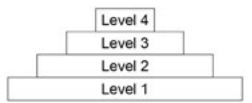 low quality aah image from the spec lol
- You need to be able to apply organisms to the pyramid and draw them in an exam.
- For example, "Level 1" might be "grass", "Level 2" might be "zebras", "Level 3" might be "cheetahs", and "Level 4" might be "lions".
- In an exam, there will be an x-axis for drawing the pyramid. Label this "biomass" and make sure to draw
each level of the pyramid corresponding to the amount of biomass in that level.
7.4.3 Transfer of biomass
- The first energy source for (pretty much, ignoring geothermal here) all life on Earth is the Sun,
flowing to the first trophic level (producers) as light energy.
- Producers convert light energy into chemical energy through photosynthesis.
- Producers then use glucose during respiration to create their own biomass, which is a chemical energy
store.
- When primary consumers eat producers, they digest the biomass and use the chemical energy to build or maintain
their own biomass.
- Likewise, secondary consumers feed on primary consumers, digesting their biomass and using the chemical energy
to grow or sustain their own biomass.
- Thus, as chemical energy passes through each trophic level, biomass is transferred as well.
- Producers (mostly plants and algae) transfer about 1% of the incident energy from light for photosynthesis.
- Only approximately 10% of the biomass from each trophic level is transferred to the level above it.
- Biomass is lost because:
- Not all ingested material is absorbed — some is egested (opposite of ingested) as faeces.
- Some absorbed material is lost as waste — e.g. carbon dioxide and water in respiration, and urea in urine.
- Not all material is even ingested in the first place — animals don't eat the _whole_ animal, and some parts of the organism will be inedible (like bones) anyway.