5.1 - Forces and their interactions
5.1.1 Scalar and vector quantities
- Every quantity is either scalar, or vector.
- Scalar quantities have magnitude but no direction.
- Vector quantities have magnitude and direction.
- A vector quantity may be represented by a vector arrow. The length of the
arrow represents the magnitude, and the direction of the arrow shows the
direction of the vector quantity.
Examples of scalar and vector quantities
| Scalar | Vector |
|---|---|
| Speed | Velocity |
| Mass | Force/Weight |
| Distance | Displacement |
| Time | Acceleration |
| Energy | Momentum |
5.1.2 Contact and non-contact forces
- A force is a push or pull that acts on an object due to the
interaction with another object.
- All forces between objects are either:
- contact forces - the objects are physically touching
- non-contact forces - the objects are physically separated.
| Contact | Non-contact |
|---|---|
|
Friction (A force that opposes the motion of an object in
contact with a surface) Air resistance (A type of friction that opposes the motion of an object moving in the air) Tension (A force that pulls two objects connected by a length (string or rope) together) Normal contact force (the force exerted by a surface perpendicular (or "normal") to the surface, in response to an object pressing against it) |
Gravitational force (The attractive force experienced by two
objects with mass, e.g. the force between you and the earth) Electrostatic force (A force experienced by charged objects which can be attractive or repulsive, e.g. proton and electron) Magnetic force (A force experienced between magnetic poles that can be attractive or repulsive, e.g. the force between the north and south poles of a magnet) |
5.1.3 Gravity
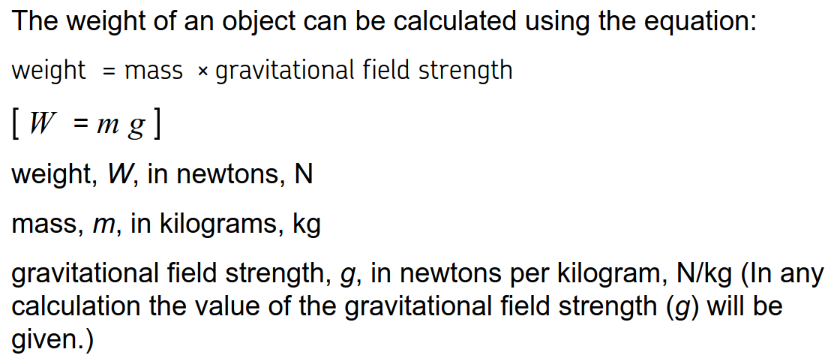
- Weight is the force acting on an object due to gravity. The force of
gravity close to the Earth is due to the gravitational field around the
Earth.
- The weight of an object depends on the gravitational field strength at
the point where the object is.
- The weight of an object may be considered to act at a single point referred
to as the object's "centre of mass".
- From the spec: