8.1 - Solar system; stability of orbital motions; satellites
8.1.1 Our solar system
- Our solar system consists of the sun, planets, dwarf planets and
moons.
- The planets orbit the sun, and moons orbit planets.
8.1.2 The life cycle of a star
- Stars will begin their life as a cloud of gas and dust (nebula)
- As gravity pulls the cloud closer together, the pressure increases and
will eventually form a protostar - Protostars are the precursors to stars
- When the matter continues to collide with itself, the temperature increase
until nuclear fusion begins
- At this point, the star is referred to as a main sequence star
- During nuclear fusion, hydrogen nuclei fuse to form helium
- The gravity from the star pulling inwards is balanced by the radiation
pressure from fusion pushing outwards, maintaining the star's size and keeping
it stable and hot
After this point, the life cycle of the star will depend on its
size
Stars that are similar in size to our sun
- After the star has run out of hydrogen, the exterior layers of the star will expand and form a red colour- Nuclear fusion will continue and form lighter metals like lithium by fusing helium nuclei
- The star will also cool slightly
- As the star runs out of helium, it will collapse due to gravity overpowering the now non-existent fusion reactions in its core
- This is known as a white dwarf, due to the colour produced from the increased temperature during the collapse of the star
- After the white dwarf has fully cooled, it will become a black dwarf, signalling the end of the life of the stars
Stars that are greater in size than our star
- After the star has run out of hydrogen, the star will expand more and form a red supergiant- Red supergiants are significantly bigger, brighter, and hotter due to the greater pressure in the core
- The outer layers of the RSG are cooler, due to the greater distance from the core
- The star will continue to fuse heavier elements in its core, up to iron
- After the star has run out of fuel, it will collapse inwards due to gravity overpowering the outwards force from fusion
- The collapse will cause a supernova, of forming a white dwarf due to the immense heat produced and high pressure.
- The supernova will expel the outer layers of the star into space, forming a nebula
- The supernova will also create heavy elements, beyond iron
- The core of the star will collapse into either a neutron star or a black hole
- Neutron stars are incredibly dense, with diameters of around 20-40km
- Black holes will form for the most massive stars instead of neutron stars.
8.1.3 Orbital motion, natural and artificial satellites
- Artificial satellites are man-made objects that orbit planets, such as
the ISS
- Natural satellites also orbit planets, such as the moon.
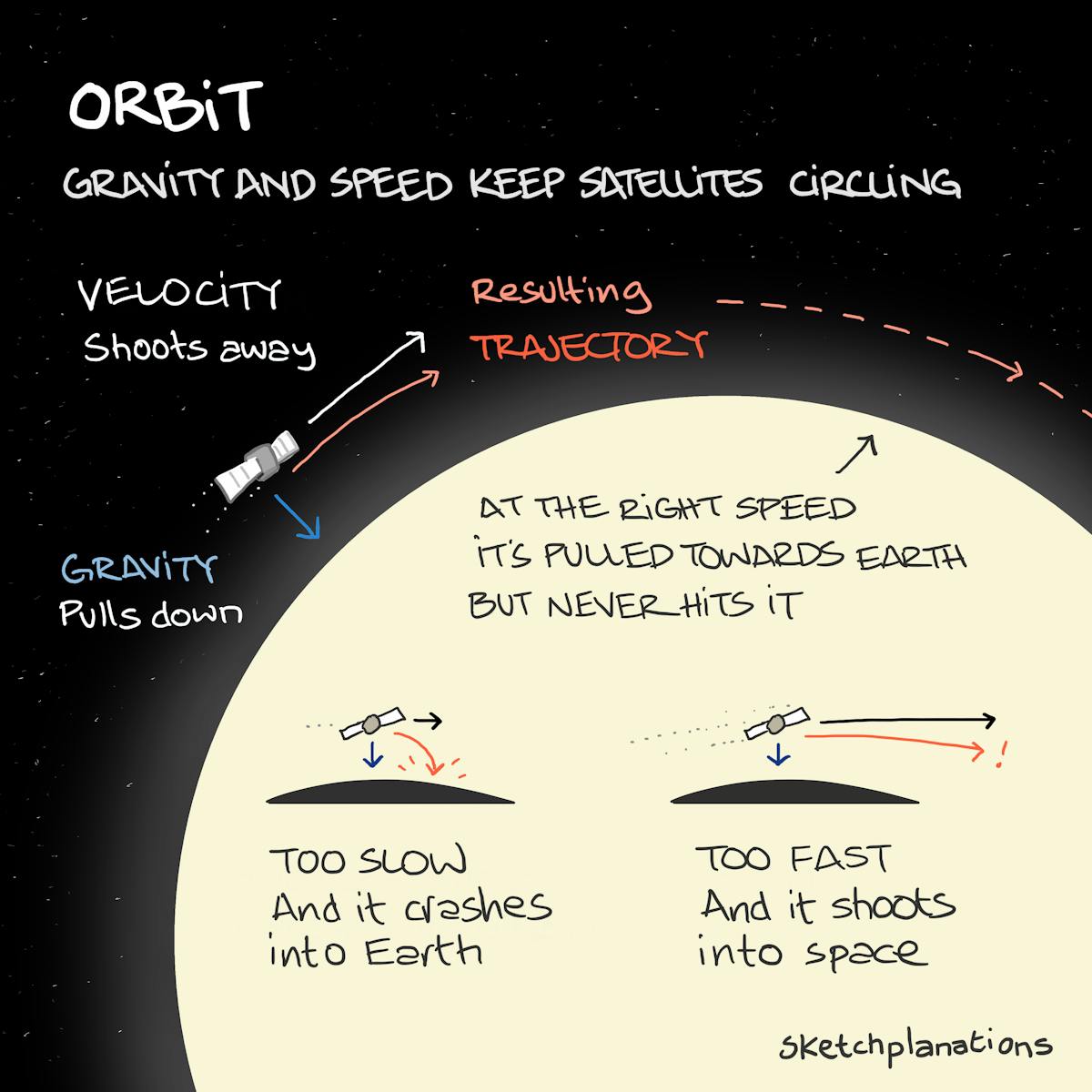
- Orbitting objects are held in orbit due to gravity.
- The orbit radius of an object is determined by the speed
- An orbitting object's speed will slowly decrease over time
- Objects in orbit will have a constantly changing velocity, but relatively
static speed.
- This is due to velocity being a vector
 from sketchplanations
- For an object to stay in orbit, it must maintain a stable speed that is
not too fast or slow (see above)